
Gravity city
Warped Manhattan
gravity anomalies
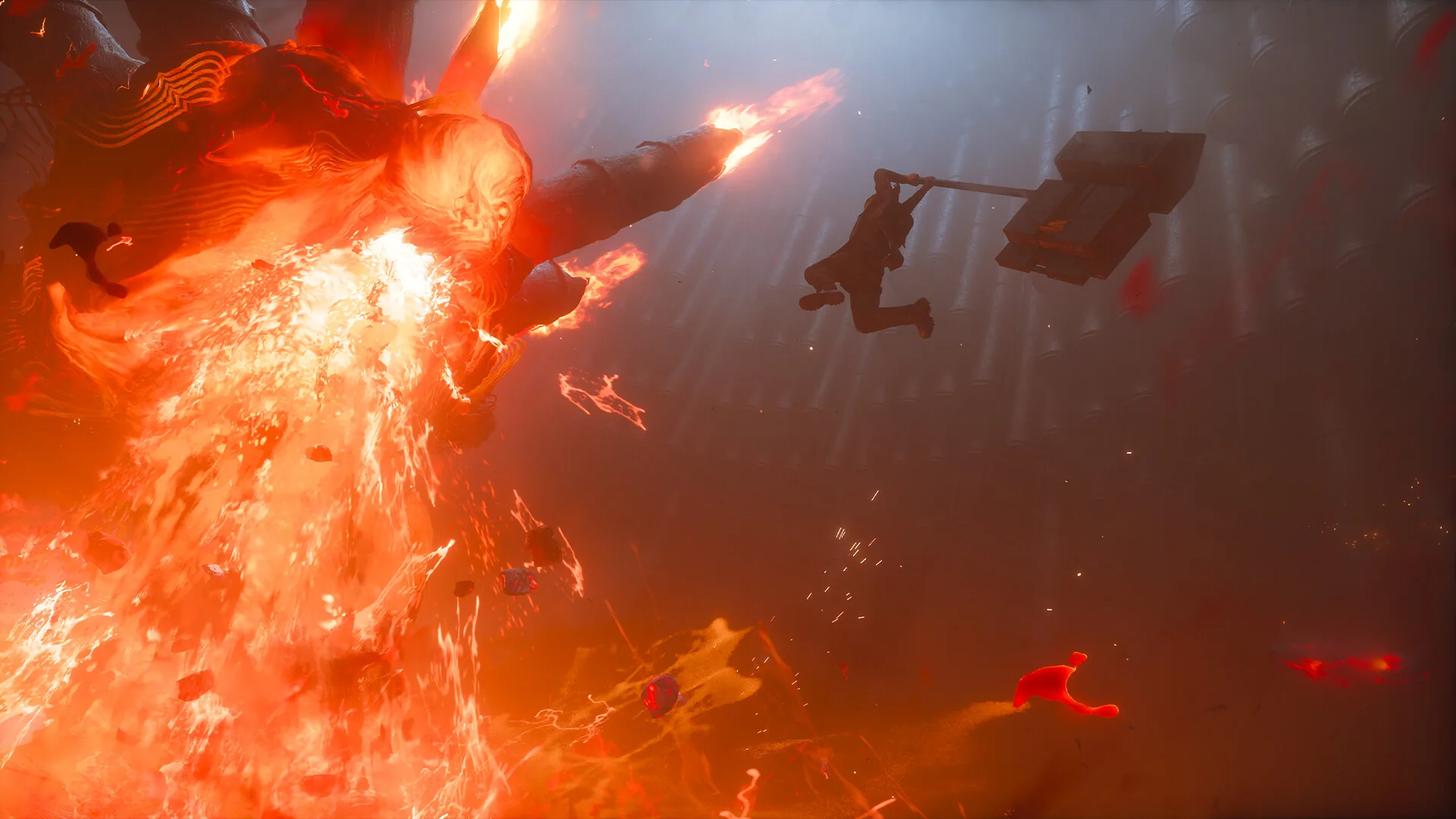
CONTROL Resonant leaves the Oldest House interiors for a ravaged Manhattan, which is the sequel's actual walkable map rather than another brutalist Bureau floor. Steam world copy names gravity anomalies that distort the vertical and horizontal plane for traversal, puzzles, and combat, plus multiple ravaged areas and perception-bending locations. Official stills show towers rotated through amber planes and streets that no longer agree on which way is down. That is the sequel's map language. Named district lists from observer guides stay out until a Bureau map dump exists. Read the gravity, then fight on it with the Aberrant.
Out of the Oldest House
CONTROL's geography was a brutalist Bureau that rearranged itself. CONTROL Resonant publishes a different verb: the city. Steam says threats have spilled beyond the Oldest House onto Manhattan streets. The FBC still exists — Dylan is still their former captive — but the play space is ravaged blocks, not another labyrinth of concrete halls. If you came for a second Oldest House campaign, the store page is the correction.
The Paranatural Manhattan trailer is the official moving picture of that shift. It sits beside the still of buildings folded across an amber plane. Use both when you are trying to answer a practical question: will I be walking on walls, and is that a puzzle or a fight? Steam's answer is both. Gravity anomalies are listed for traversal, puzzles, and combat in one sentence, so the same distortion that opens a shortcut can also dump a Hiss body onto you from what used to be a facade.
How gravity anomalies change a fight
A gravity anomaly in CONTROL Resonant is not a jump-pad cosmetic. Steam describes distortion of the vertical and horizontal plane. That means floors become walls, sightlines fold, and the Aberrant's hammer arc has a new down. Dual-wielded blades care about that too: swift precision on a plane that just rotated is a different timing problem than the same cuts on flat asphalt.
Perception-bending locations sit next to the ravaged outdoor streets. The store promises more than one city area. It does not publish a seven-zone spreadsheet. Observer maps that name districts and sensor pylons are useful as community notes and stay labeled that way. The verified player task here is simpler: expect multiple Manhattan areas, expect the plane to lie, and expect combat and puzzles to share the same distortion.
Steam lists the same distortion for traversal, puzzles, and combat. A shortcut on a folded facade can dump a Hiss body onto you. Perception-bending rooms are the indoor cousin of that outdoor fold, still without a seven-zone official spreadsheet.
What occupies the warped streets
The Hiss is named as chaotic resonance in the city. The Mold is named as an invasive micro-organism. A mysterious cosmic entity is named as the force rewriting reality. Resonants sit above those as the biggest, toughest enemy class. Manhattan is not an empty playground for gravity toys; it is the place those four published threats actually occupy.
Dylan is deployed into that mix, not past it. Assist Mode sliders for Enemy Aggression and Enemy Projectile Speed exist because off-screen swarming and incoming fire are part of the street. If a block feels unreadable, it may be the plane, the Hiss light, or a slider you have not opened yet. Pair Resonants for threat roles with the Aberrant for the melee answer on a floor that will not stay a floor.
Steam also promises perception-bending locations alongside the outdoor wreckage. That is the indoor cousin of a gravity anomaly: a room that lies about its axes. Traversal, puzzles, and combat share the same distortion, so a puzzle route can become a kill box when a Resonant occupies it. The Paranatural Manhattan trailer is the official motion proof; the still of rotated towers is the still proof. Together they are the map language until a first-party zone list exists.
Dylan's deployment into the city
The FBC sends Dylan into Manhattan because House lockdown already failed. Jesse is missing inside that failure. Gravity anomalies are how the city fights back against ordinary walking. The Aberrant is how Dylan fights back against the things that now live on those planes. Those four facts are the street briefing: Bureau, Director, warped map, melee weapon.
Assist Mode Enemy Aggression names off-screen swarming, which is a city-block problem, not a corridor problem. Enemy Projectile Speed is the same. If a gravity fold hides a shooter on what used to be a wall, that slider is the published response. Manhattan is the reason those two Assist rows exist alongside Perfect Dodge Window.
The FBC deploys Dylan because House lockdown already failed. Jesse is missing inside that failure. Assist Mode Enemy Aggression names off-screen swarming, which is a city-block problem the Aberrant then answers at melee range.
Sources